When you connect to WizNET, your receiver shows a list of mountpoints. The two you will use most are RTCM32-MSM, a VRS (Virtual Reference Station) solution, and RTCM-3X-MSM, corrections from the nearest physical base station. Both give centimetre-level RTK, but they work differently, and knowing the difference helps when a fix is slow or a job sits at the edge of the network.
Key Takeaways
- VRS (RTCM32-MSM) uses data from several reference stations to create a virtual base close to you. It is the best choice for most work.
- Single base (RTCM-3X-MSM) streams corrections from the nearest physical station. Accuracy depends on how far you are from it.
- VRS needs your receiver to send its approximate position to the network; most modern receivers do this automatically.
- Use single base when you are close to a station, when VRS will not connect, or when troubleshooting.
- RTCM-30 streams are only for older receivers that cannot use the MSM formats.
How VRS Works
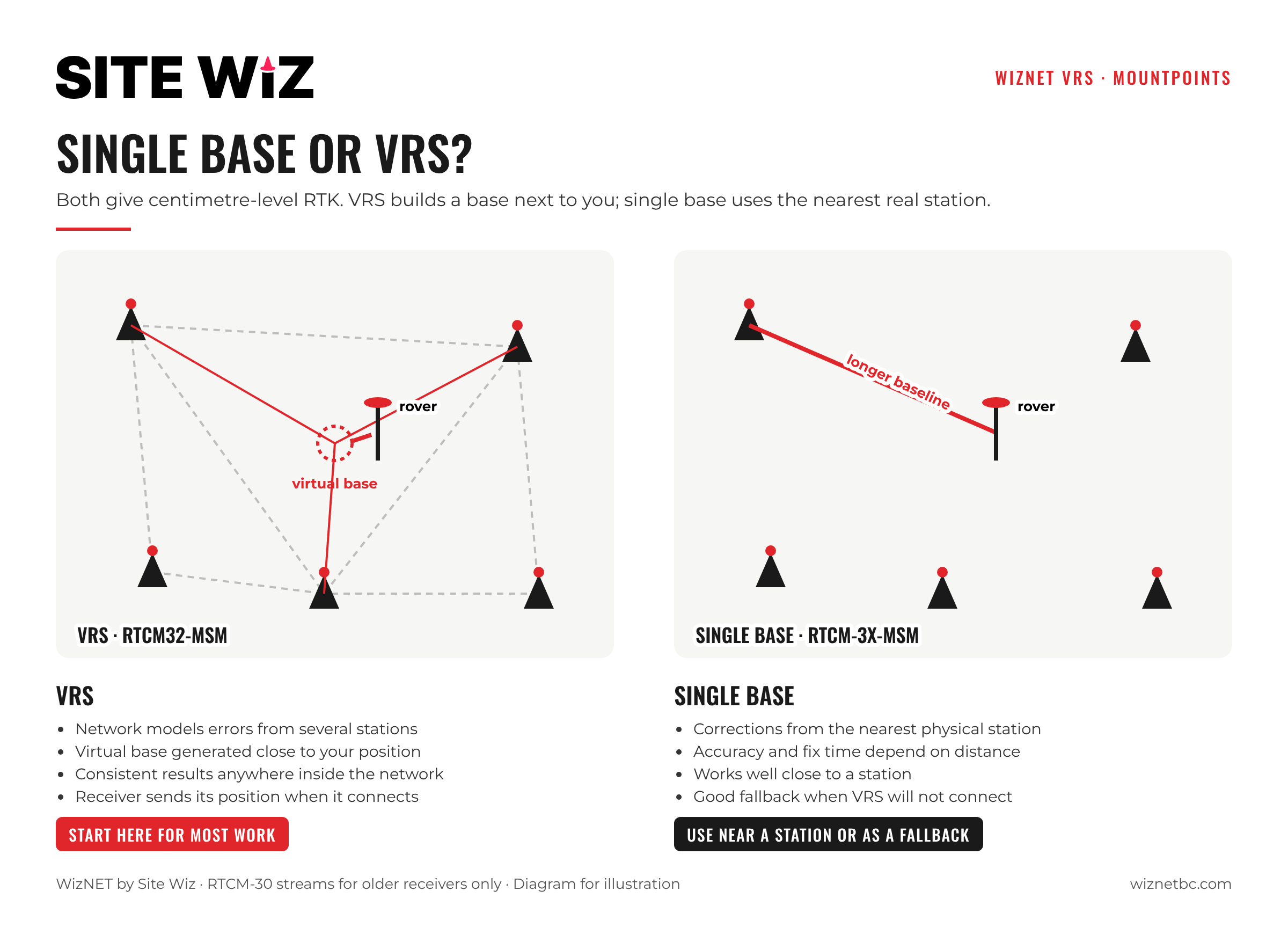
With VRS, your receiver sends its approximate position to the network when it connects. The network uses data from the surrounding reference stations to model errors such as atmospheric delay across the area, then generates corrections as if a base station were set up right next to you.
Because the virtual base is close, the distance between base and rover stays short wherever you work inside the network. That gives more consistent accuracy from one site to the next.
How Single Base Works
A single base mountpoint streams corrections from one physical reference station, the one nearest to you. It works the same way as setting up your own base, except the base is already there.
The trade-off is distance. The further you are from that station, the more the conditions at the base differ from the conditions at your rover, and the more your accuracy and time to fix can suffer. Close to a station, single base works very well.
Which One to Use
| Situation | Use |
|---|---|
| General surveying, layout and mapping inside the network | VRS (RTCM32-MSM) |
| Working close to a reference station | Either; single base is a good option |
| VRS will not connect or fix | Try single base (RTCM-3X-MSM) |
| Receiver cannot send its position to the network | Single base (RTCM-3X-MSM) |
| Older receiver that cannot read MSM messages | RTCM-30 streams |
If you are troubleshooting a slow fix, switching mountpoint type is a quick test. Our RTK Float vs Fixed guide covers the other checks.
Mountpoints on WizNET
- RTCM32-MSM: VRS solution. Start here.
- RTCM-3X-MSM: single baseline from the nearest physical base station.
- RTCM-30: VRS and nearest-base streams for older receivers, only if the two above do not work.
All streams support GPS, GLONASS, Galileo and BeiDou. Step-by-step setup is in our guides for Emlid Reach and Topcon MAGNET Field and Pocket-3D. For the background on network RTK, see how RTK networks work.
Frequently Asked Questions
Is VRS more accurate than single base?
Inside the network, VRS usually gives more consistent results because the virtual base is always close to you. Next to a physical station, single base can perform just as well.
Why does VRS need my position?
The network uses your approximate position to generate a virtual base near you. Most modern receivers send it automatically when they connect.
Can I switch mountpoints in the field?
Yes. Request the mountpoint list again in your field software and select the other stream.
Which mountpoint does my subscription include?
All of them. Both monthly and annual plans include every WizNET mountpoint.